
How We Approach BPM and BPI
Business Process Management (BPM) and Business Process Improvement (BPI) provide the foundation for understanding how work is performed across an organisation. Effective process mapping creates shared understanding, supports analysis, and enables improvement — regardless of the methodology or standard used.
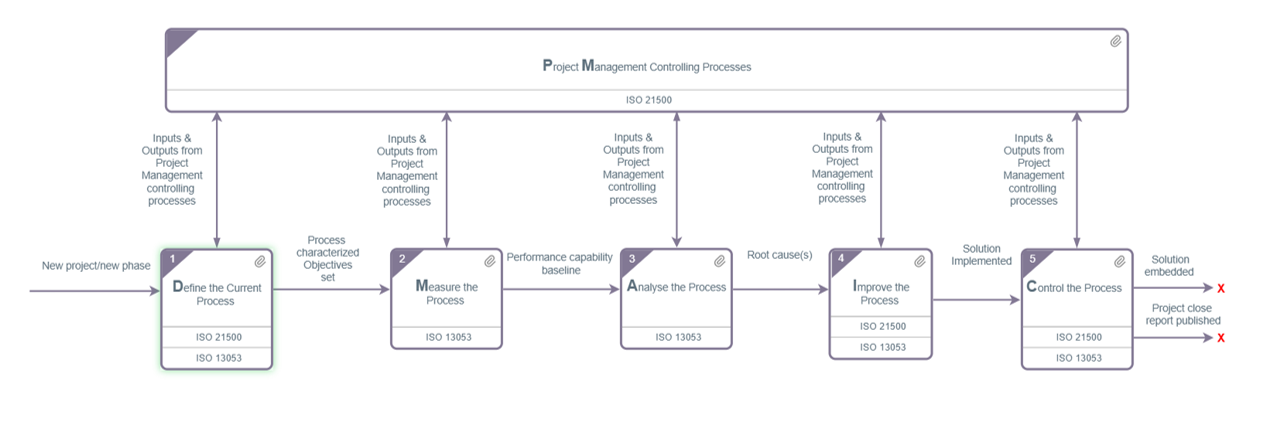
Within DMAIC, process maps are commonly used during the Define phase to clarify scope, understand the current state, and frame problems effectively. However, DMAIC does not prescribe how processes should be mapped, nor does it mandate a specific notation or modelling standard.
For this reason, we treat BPM/BPI as a distinct but complementary capability. We support organisations in developing strong process mapping practices using approaches such as SIPOC or BPMN, and in selecting appropriate platforms to create, manage, and reuse process knowledge across the enterprise — without constraining organisations to a single method or tool.
BPM and BPI provide the tools to understand and improve processes. Enterprise Process Architecture provides the structural context that ensures those efforts are aligned, prioritised, and scalable at enterprise level.
Enterprise Process Architecture & Transformation
Effective process enablement begins with architectural clarity. Before tools, training, or transformation initiatives are deployed, organisations must understand their enterprise process structure.
Strategic clarity before transformation.
Before launching improvement, digitisation, or AI initiatives, organisations need architectural visibility of how the enterprise operates.
Our Enterprise Process Architecture service provides a structured Level 1–2 model of your organisation’s processes, aligned to strategy and independent of silos.
Using a framework derived from the APQC PCF and delivered through ISO 13053 aligned Define–Measure–Analyse methodology, we establish:
Enterprise process visibility
Governance & ownership clarity
Capability maturity insight
Strategic alignment
Digitisation prioritisation
This becomes the foundation for structured DMAIC implementation, Operational Excellence, and digital transformation and process digitisation programmes.
Explore how architectural clarity can accelerate your transformation journey.
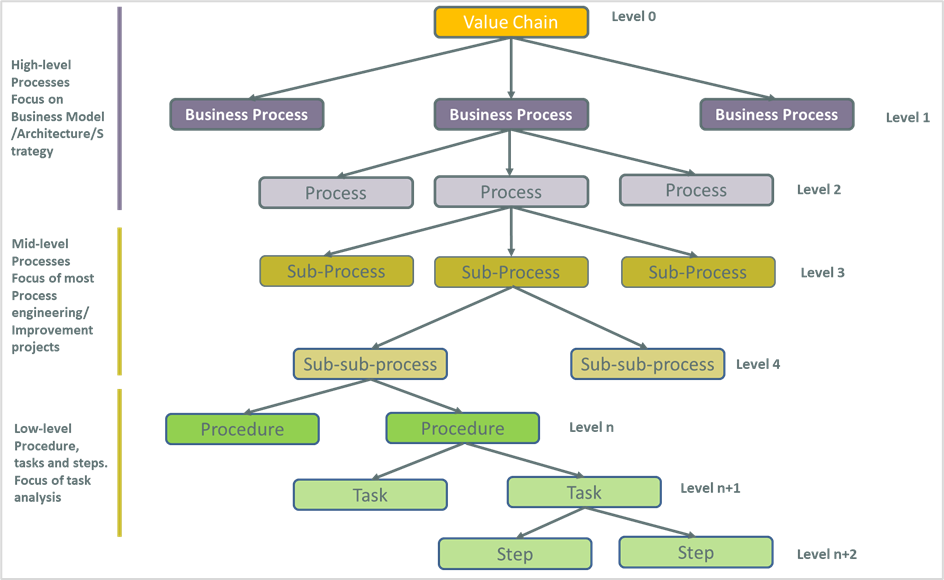
Conceptual diagram of levels in a business Model/process architecture
Frequently Asked Questions: Enterprise Process Architecture
-
Process Architecture provides a hierarchical enterprise-level model (Level 1–2) aligned to strategy.
Process mapping focuses on operational workflows at detailed levels.Architecture is strategic.
Mapping is operational. -
IIt provides visibility of process ownership, capability maturity, and interdependencies — enabling rational prioritisation of automation and digitisation initiatives.
Without architectural clarity, digitisation risks automating inefficiency.tem description
-
The engagement focuses on Level 1 and Level 2 processes.
Inputs, outputs and detailed task-level flows are not mapped at this stage.The goal is strategic clarity — not operational micro mapping.
-
Typically senior leadership and cross-functional process owners.
Enterprise architecture is a strategic exercise, not a departmental activity.
-
Typically six facilitated workshops over approximately three weeks (dependent on scope and availability).
-
Enterprise Process Architecture establishes the structural foundation upon which DMAIC, Operational Excellence, and digital initiatives can be prioritised and governed effectively.
-
Yes. In fact, improvement efforts are significantly strengthened when anchored to a clearly defined enterprise process architecture.
Business Process Mapping
Turning process documentation into business transformation.
Business Process Mapping is a foundational capability that underpins effective DMAIC, digital transformation, and process improvement initiatives.
Business Process Maps do more than document your ‘As-Is’ processes - they drive efficiency, compliance, and digital transformation.
Why Business Process Mapping Matters
The foundation of every successful BPM or BPI initiative
Whether your focus is digitisation, cost reduction, or compliance, mapped processes form the foundation of effective Business Process Management and Improvement.
Digitisation
Enterprise System Implementations
Digitisation of Processes
Digitalisation of Transactions
Workflow and RPA
Cost
Transformation Programmes
Process harmonisation
Eliminate waste
Reduce variation
Outsourcing & Insourcing
Partner collaboration
Right-sizing
Regulation
Audit readiness
Lower Cost of Compliance
Faster response to new regulation
Improved compliance profile
Why We Map Business Processes
Discover how mapping adds measurable value to your organisation.
Watch our short video and download the “What’s In It For Me” paper to explore how BPM can make a difference to you, your team, and your business.
Ready to Map?
We provide everything you need to get started with Business Process Mapping:
Access to our online course
An Elements.cloud licence
Individual expert review
A Business Process Platform
Elements.Cloud helps organizations improve operational efficiency, align business processes with their technology stack, and drive continuous improvement.
Benefits:
Single platform and repository
Supports discovery, mapping, management
Integrates with Salesforce
Used by Torque in delivery

Establish a Mapping Standard: Universal Process Notation (UPN)
Most organisations document processes inconsistently - leading to overlap, confusion, and multiple versions.
UPN (Universal Process Notation) offers a simple, standardised approach designed by business users, for business users. It’s easy to read, easy to share, and provides the foundation for scalable BPM and BPI initiatives.
Consistent
One simple visual language everyone can read
Collaborative
Makes process maps easy to share and improve together
Compliant
Supports audit, quality, and regulatory documentation
Connected
Integrates process maps with your digital platforms